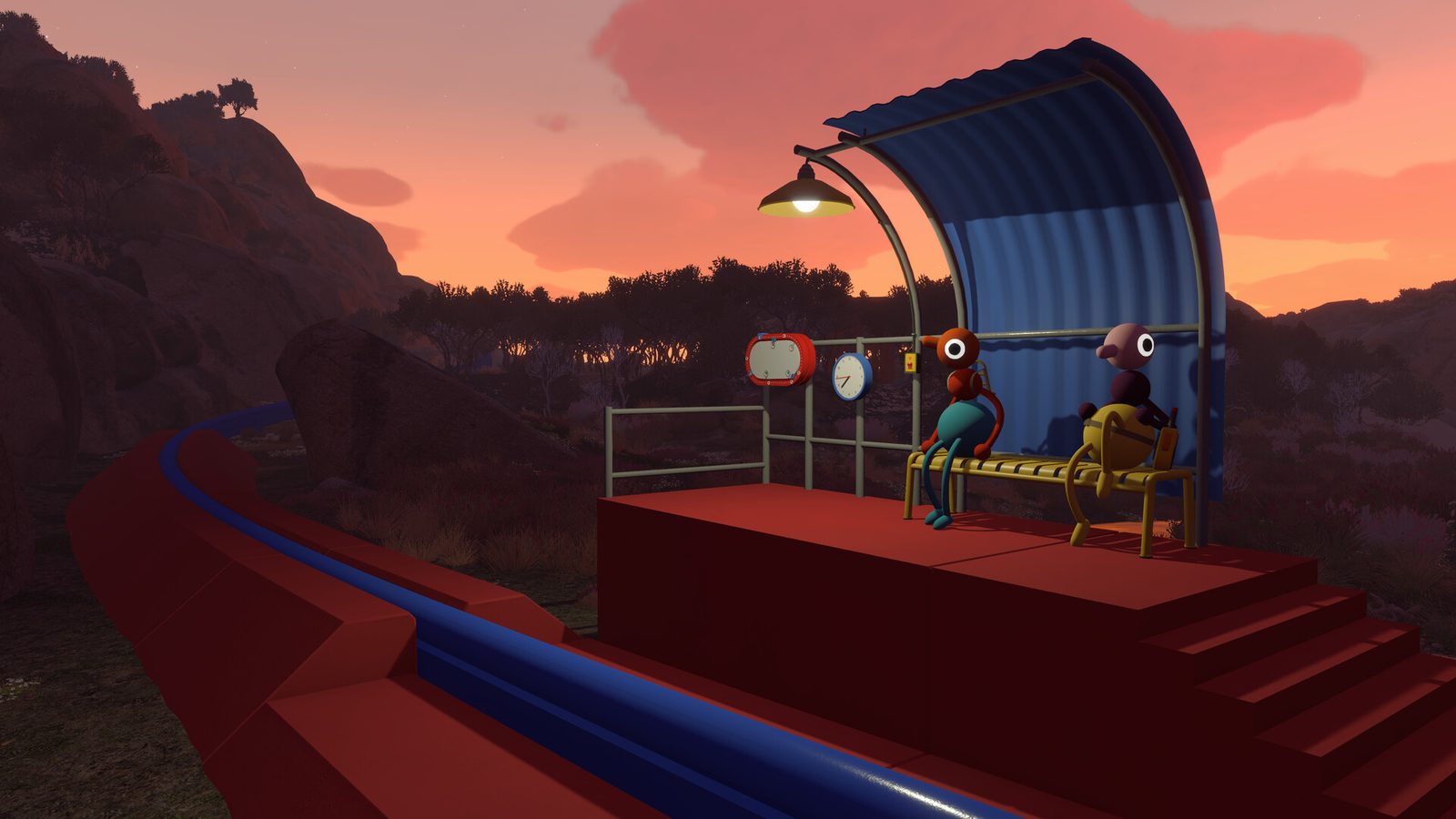
Big Walk’s puzzles do not always reward talking. Some rooms muffle speech, others separate teams with soundproof glass, and open-world exploration routinely splits parties beyond comfortable shouting range. Signaling tools close that gap: visual markers, amplified voice, writable boards, and silly audio beacons that help friends find each other without opening Discord.
House House’s design philosophy gives every tool a job — and lets the job be funny. A megaphone is amusing on a hilltop and genuinely useful during coordinated climbs; a cowbell is both a tracking aid and a griefing invitation; the whiteboard supports serious puzzle notation and juvenile “kick me” signs stuck in backpacks. Fun and function are the same system.
The signal toolkit at a glance
| Tool | Signal type | Best for | Limits |
|---|---|---|---|
| Signal flare | Visual, long range | Regrouping across valleys, fog, night | Consumable; one per four players recommended |
| Megaphone | Voice amplification | Large lobbies, coordinated climbs | Nearby listeners only; no obstacle penetration |
| Laser pointer | Visual, silent | Soundproof rooms, “do not shout” puzzles | Line-of-sight only |
| Cowbell | Audio rhythm | Timing gates, tracking a moving player | Easy to substitute with voice counts |
| Whiteboard | Persistent text | Puzzle notation, group memory | Slow for quick calls; readable only up close |
| Binoculars | Scout | Spotting distant gates before routing | Not a signaling tool — a scouting companion |
How each tool interacts with the voice rules
The tools are interesting because of how they bend the proximity voice model from the mechanics guide:
- Flares answer the oldest co-op question — where are you? — without relying on voice at all. In fog, at night, or across a valley, a flare is the strongest visual marker in the game. The tier list calls one flare per four players a safe minimum, and the party planner assigns one per sub-team for organized runs.
- Megaphones push your voice further for nearby listeners. They shine in six-to-twelve-player lobbies where one leader must reach many people spread across an open area. Overkill for duos.
- Laser pointers are the silent option: a visible beam that marks exactly what you mean without a word. They shine in soundproof-glass rooms and anywhere a shout would break the puzzle.
- Cowbells add an audio rhythm layer. Their ringing carries through moderate distance and foliage, which makes them a practical way to track a player who keeps disappearing into terrain — and an easy way to announce a charge. The timing trick is optional flavor; the tracking value is real.
- Whiteboards persist. When speech is disabled or a puzzle state must survive backtracking, the board carries the plan. It is slower than a laser for quick calls but unmatched for notation.
- Binoculars are the scouting companion to all of the above: spot the gate, the route, or the teammate first, then decide which signal tool answers the situation.
Building a loadout that covers all three channels
A balanced group covers three communication channels — voice, visual, and written:
- Voice channel: at least one walkie-talkie per sub-team (range + obstacle penetration), megaphone for the lobby leader in big groups.
- Visual channel: flares for regroup, a laser pointer for silent marking, binoculars with a scout role for route reading.
- Written channel: one whiteboard per team whenever puzzle notation or complex states are expected.
The tier list ranks these by party size, and the party planner turns the ranking into concrete roles for 2, 4, 6 and 12 players. The short version: if your backpack only fits three communication items, default to walkie-talkie + flare + binoculars, and let arms handle the rest.