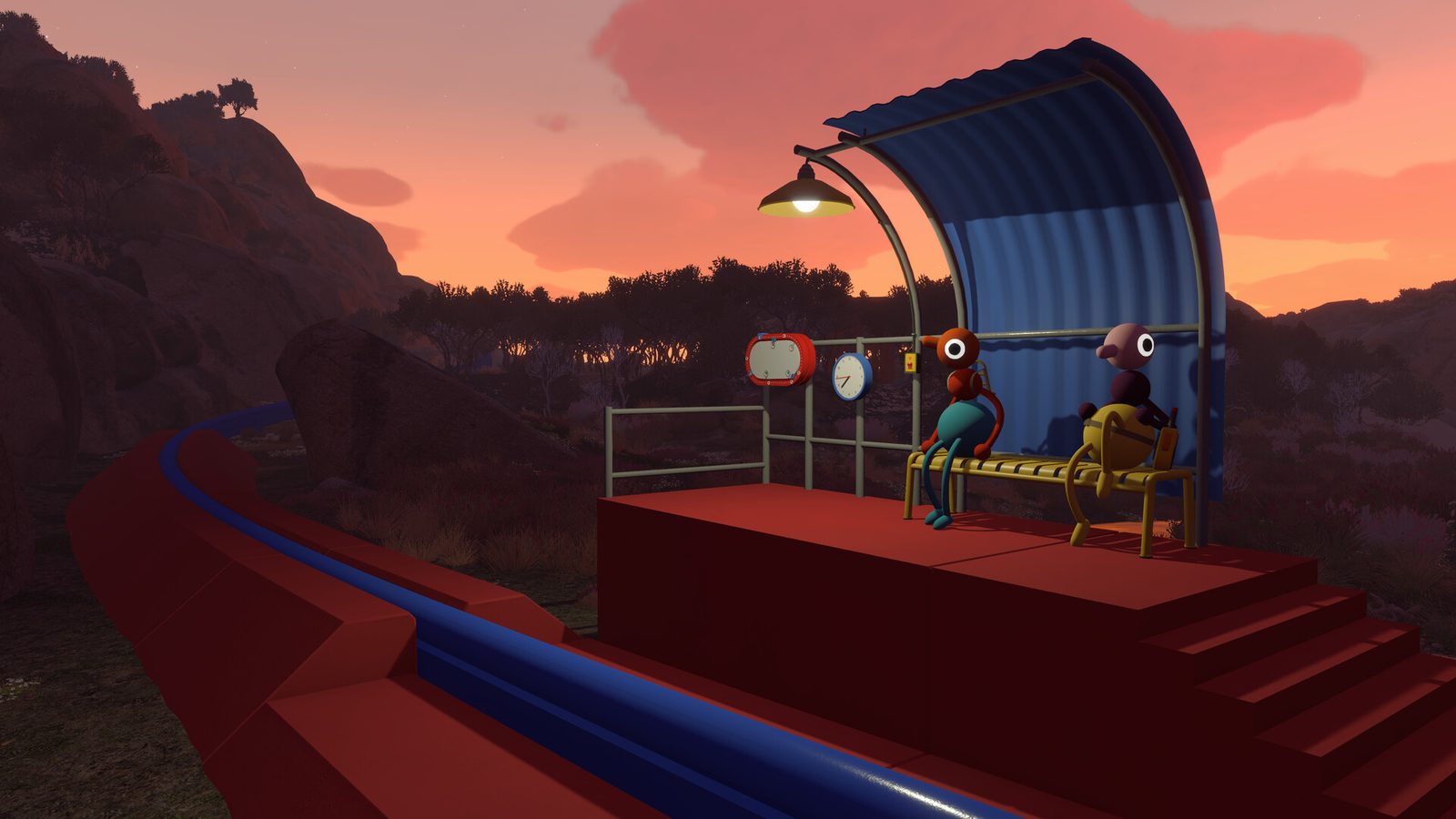
Big Walk is not a game with a chat box bolted on — communication is the game. Its rules are deliberately physical: sound travels through the island the way it travels through the world, and the tools you carry change what your teammates can hear and see. This page collects the underlying systems, what they mean in practice, and what the game deliberately leaves out.
Proximity voice model
Voice in Big Walk behaves like a physical signal rather than a static chat channel. Your voice is not a constant stream — it travels, bounces, and fades based on distance, obstacles, and environment.
Distance attenuation
Voice volume drops smoothly the further you get from a teammate. The official description confirms that voices fade across distance, but it never publishes exact meter ranges. Footage and developer comments suggest a smooth falloff rather than a hard cutoff, so you will rarely hear an abrupt “now you can’t hear me” boundary.
Note: None of the official materials publish meter-accurate distance thresholds. Numbers quoted in videos or previews should be treated as observations rather than guaranteed rules.
Environmental effects
| Environment | Voice effect |
|---|---|
| Open field | Clear, fades naturally with distance |
| Corridors / caves | Echo and reverb |
| Through walls | Muffled, reduced clarity |
| Soundproof glass | Completely blocked (visual only) |
| Walkie-talkie | Crackling, radio-style distortion |
Text chat restrictions
Text chat follows the same rules as voice — an unusual design choice, since most games treat text as a reliable fallback:
- Messages become unreadable at distance
- Soundproof glass blocks text as well as voice
- Walkie-talkies affect text transmission
- No global chat channel exists
The practical takeaway: plan callouts around the environment, not around a fallback chat box. If you split up, carry a walkie-talkie or agree on visual signals before the glass comes down.
Tool behaviors
The tool set exists to bend the proximity rules, not to replace them:
- Walkie-talkie — a ranged communication tool. While held: your voice carries further than normal speech, audio gains a distinctive crackling effect, and text chat can also be transmitted (confirmed by the official FAQ). The signal punches through walls and glass that would normally stop your voice.
- Laser pointer — a pointing tool that creates a visible beam other players can see. Useful when words fail, or for indicating something without speaking — especially in soundproof rooms.
- Binoculars — zoomed observation of distant areas. The official description jokes that friends can steal them and kick them into the ocean, which is a reminder that they are physical objects that can be dropped or taken.
Flares, megaphones, cowbells and whiteboards also bend the voice rules in their own ways — see the signaling tools guide for the full toolkit and a loadout strategy that covers voice, visual and written channels.
Gesture system
Every player has arms for non-verbal communication:
- Pointing — direct attention to objects or directions
- Waving — attract attention or signal your location
- Flailing — express urgency or confusion
These are not emotes. Official materials describe them as essential tools for situations where voice is unavailable or inappropriate — split puzzle lanes, soundproof glass, or just the polite distance of a ridge. See the controls guide for a full signal vocabulary.
Session structure
World versions
The host selects a world version adapted to the expected group size:
| Version | Minimum players | Design focus |
|---|---|---|
| 2-player | 2 | Intimate, focused cooperation |
| 3-player | 3 | Small group dynamics |
| 4+ player | 4 | Chaotic, larger group play |
The overall maximum is 12 players regardless of version. The choice affects puzzle design and world layout, not hard player limits — the world is tuned for the group, not gated by it.
Host authority
- The host owns the save file
- The session ends when the host disconnects
- Returning to a saved journey requires the original host
- No save transfer or host migration is officially documented
Plan recurring hikes around who can host, and keep the host’s connection healthy — see the hosting guide for session etiquette and disconnect recovery.
What Big Walk does NOT have
- Random matchmaking
- Single-player campaign
- Global voice or text channels
- External voice chat integration (absent by design; community guides read this as a nudge toward in-game comms)
- Traditional MMO-style persistent world
Understanding the “no” list matters as much as the feature list: Big Walk commits to a design where the group’s own voice, arms, and tools are the entire communication stack. Bring the right tools, agree on signals, and the limitations become the gameplay.